


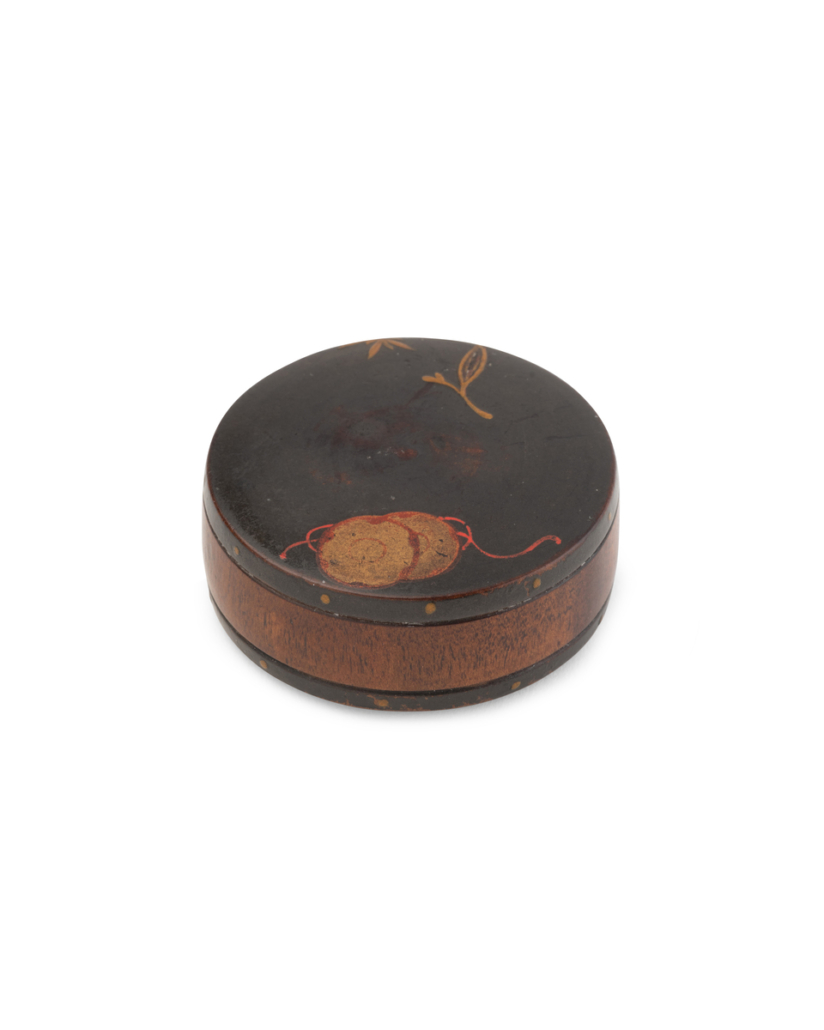
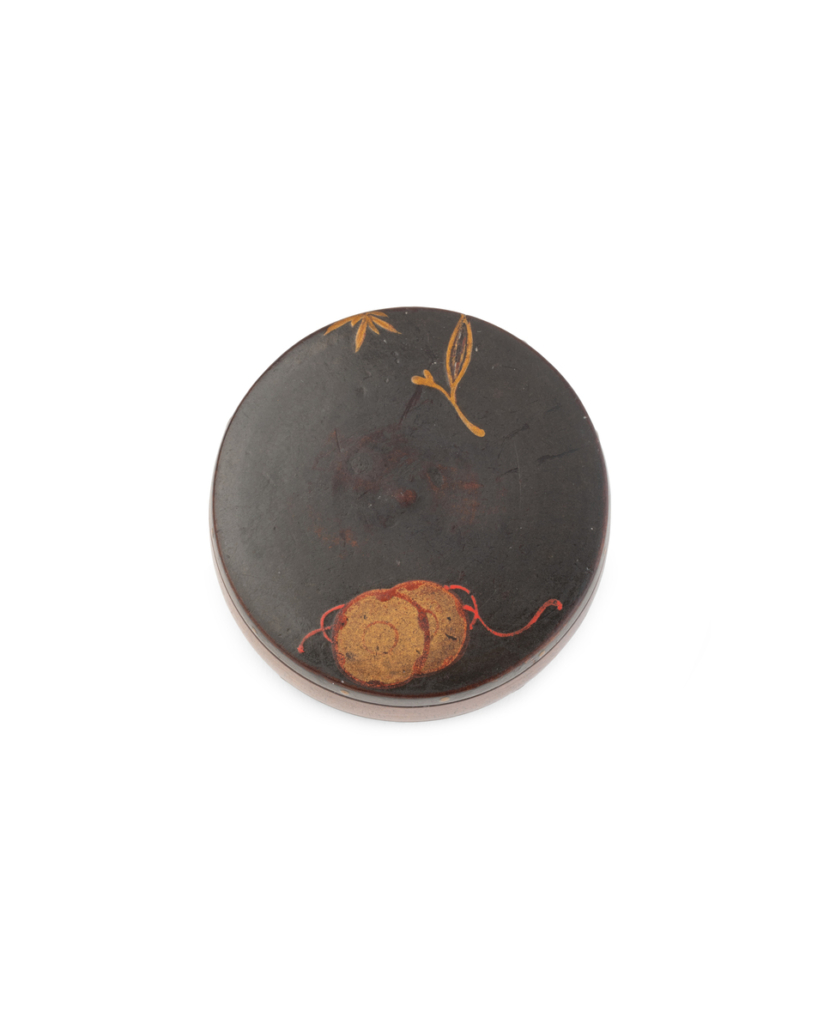

A WOODEN CARVED AND LACQUERED DRUM NETSUKE – EDO
Référence : 2025 – 1431
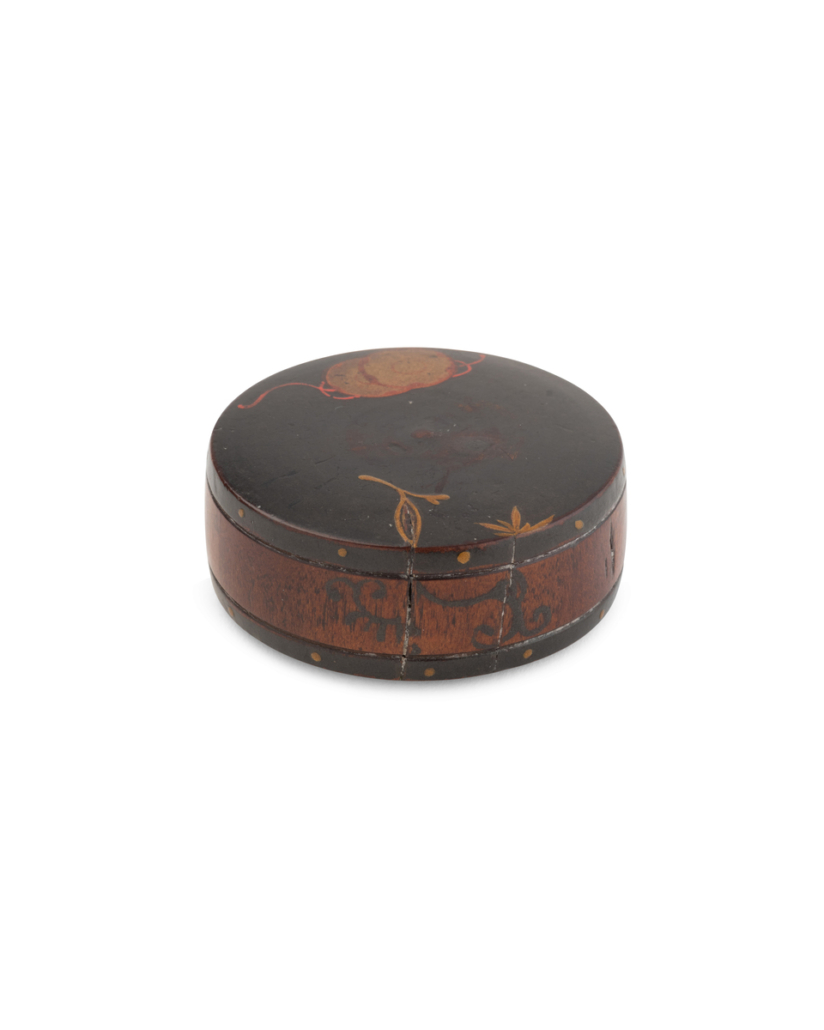
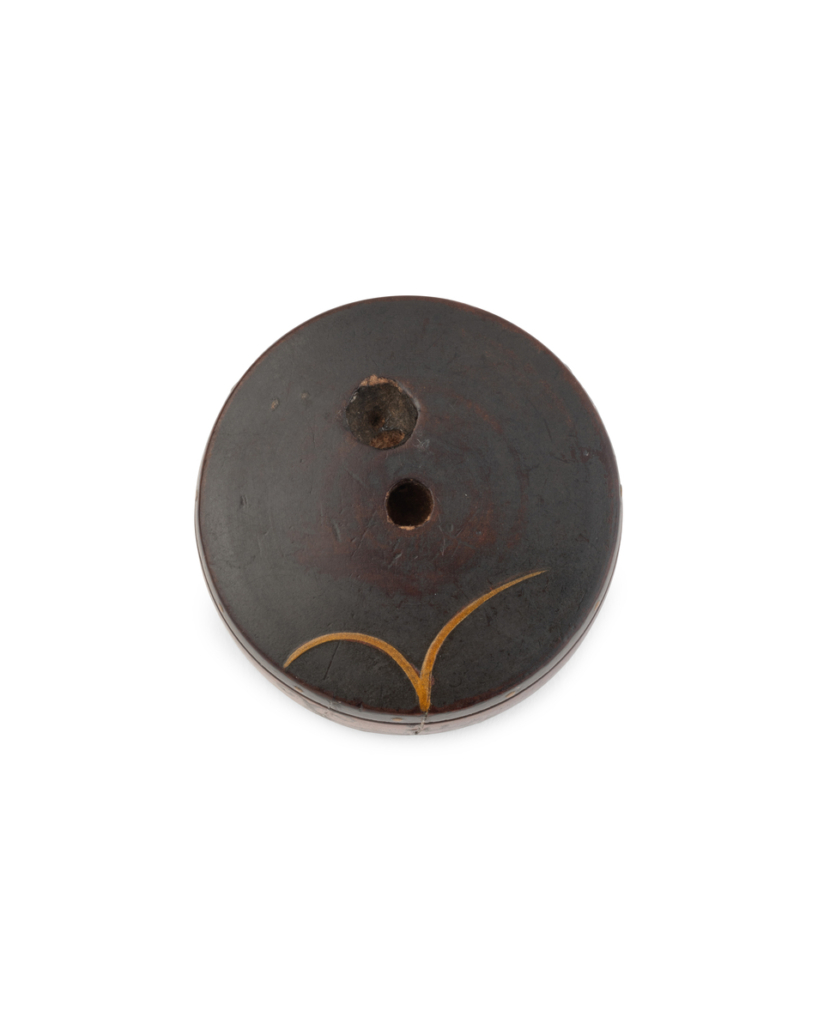
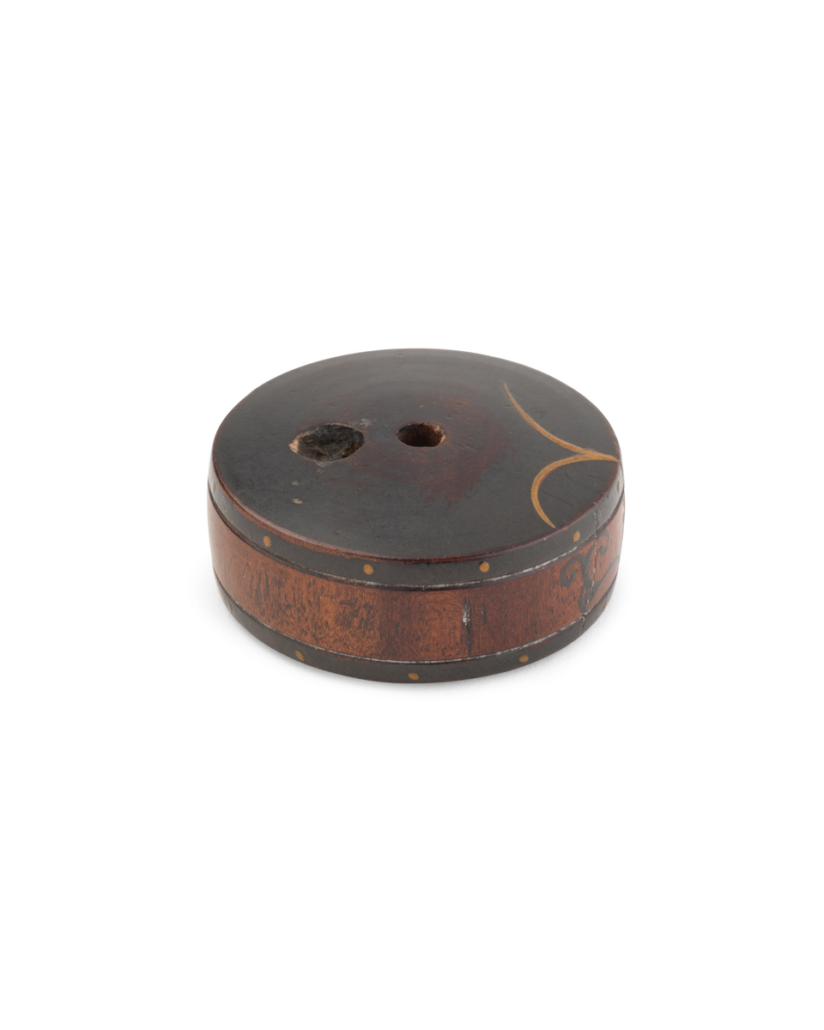
Manju netsuke in lacquer and maki-e on a grey-blue ground, shaped as a traditional taiko drum and decorated with foliage. Himotoshi pierced beneath the base.
Round or oval in shape, the manju netsuke takes its name from a round, puffed steamed cake whose recipe was introduced from China at the beginning of the 13th century by Shōichi Kokushi, a monk and founder of Tōfuku-ji, a Buddhist temple in Kyoto. These cakes were believed to have the power to expel harmful breath associated with the change of seasons. Although most manju netsuke were made of ivory, examples in iron or wood—either plain or lacquered—are also encountered.
Most examples, as in the present case, generally measure between 2 and 6 centimeters in diameter. Their round shape, reminiscent of modern buttons, earned them the nickname “mandarin button,” although this comparison is entirely incorrect with regard to their actual function.
Several attachment systems were commonly used. Here, the manju is carved from a single block and pierced with two holes to allow the cord of a potential netsuke attachment to pass through.
The term taiko broadly refers to a wide variety of Japanese percussion instruments, remarkable for their diversity depending on their intended use. Taiko drums were introduced to Japan as early as the 6th century through Chinese and Korean cultural influences, and pottery dating from the Kofun period (3rd–6th century) depicting drums has been found in various regions of the archipelago. At that time, these instruments were primarily used as means of communication or in the context of both secular and religious festivals.
According to a legend recorded in the Nihon Shoki—the second-oldest book of classical Japanese history, completed in 720 and presented to Empress Genshō—the taiko drum was invented during an outburst of anger by the sun goddess Amaterasu. She withdrew into a cave, plunging the world into darkness and forcing the other deities of the Shintō pantheon to attempt to persuade her to emerge. One by one they tried, but each attempt failed, as Amaterasu stubbornly refused to leave her refuge. It was only when Ame-no-Uzume, the goddess of humor, dance, and joy, emptied a barrel of sake and danced wildly upon it that Amaterasu emerged from her silence, her anger, and finally from the cave itself. Thus, according to legend, the taiko drum was created.
The instrument was also used in military contexts, notably during the Sengoku period (15th–16th centuries), when the need to communicate orders was paramount. Finally, the taiko was—and remains—widely used during various festivals as well as in kabuki theatre performances.
Japan, late Edo period, 19th century (1868–1912)
Diameter: 4.7 cm – Height: 2 cm