


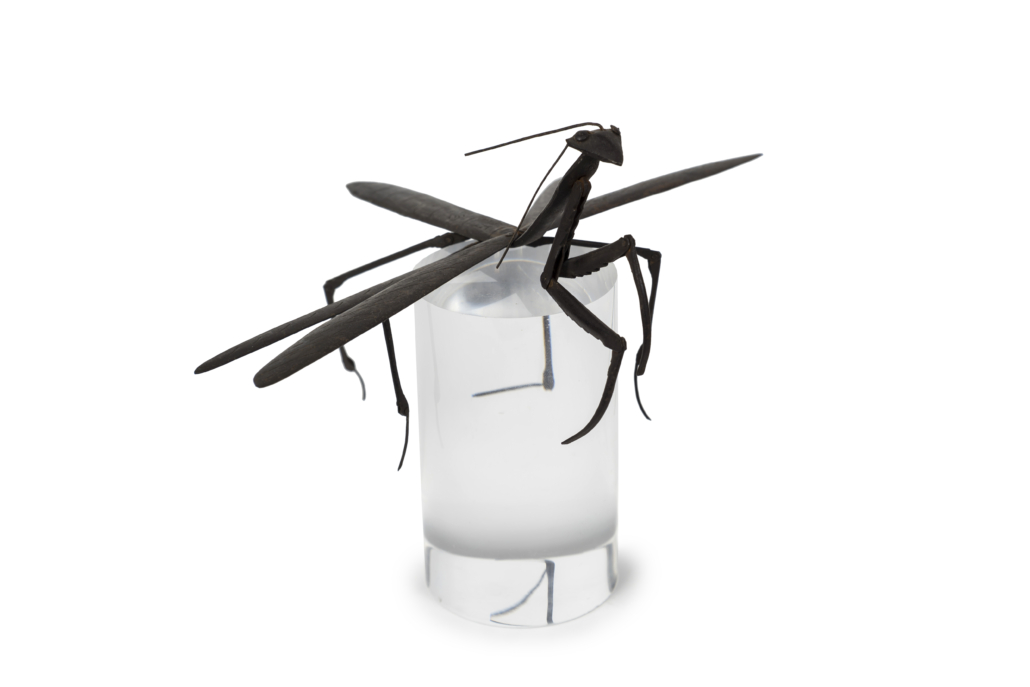
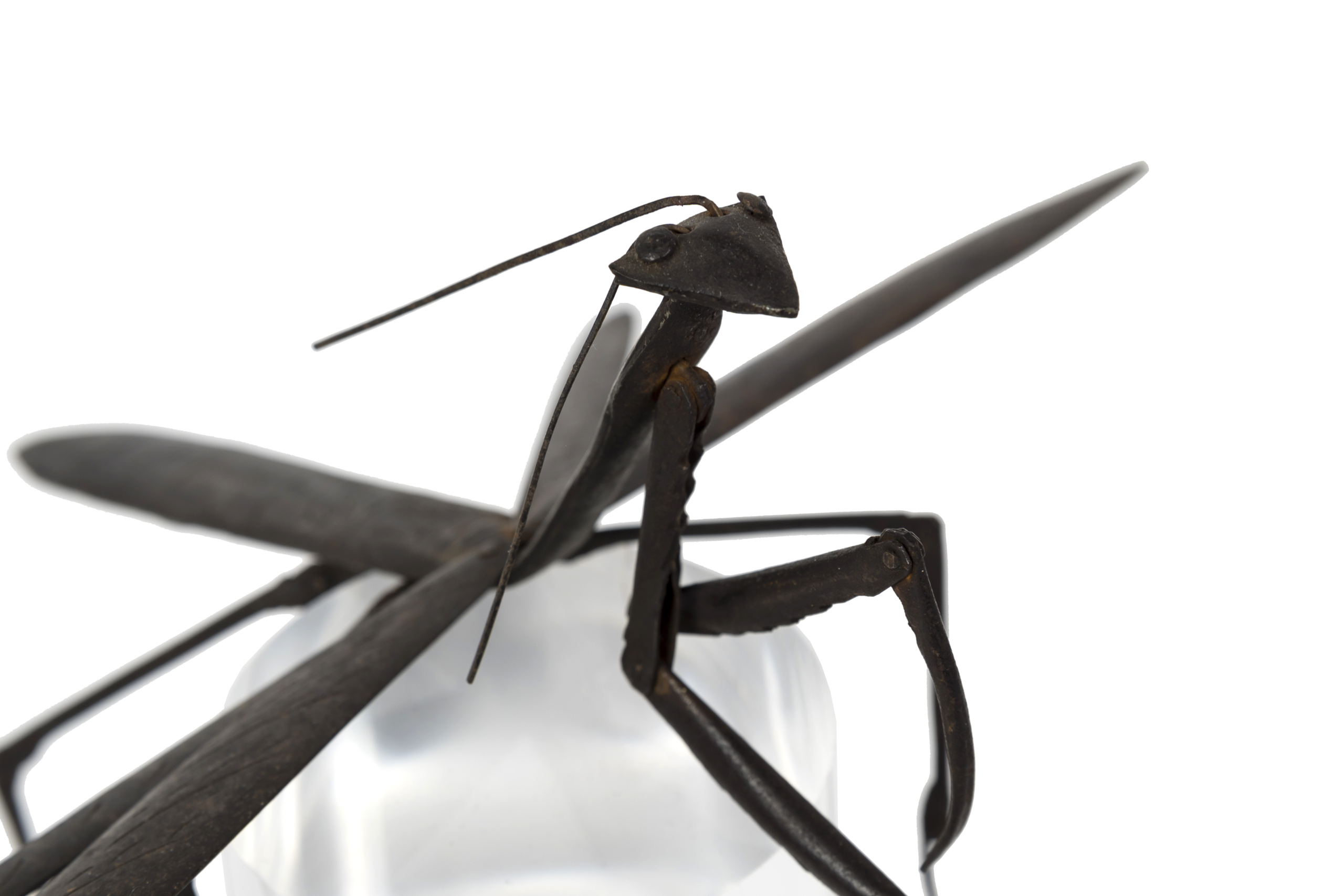

PRAYING MANTIS JIZAI OKIMONO
Référence : 2025-1385
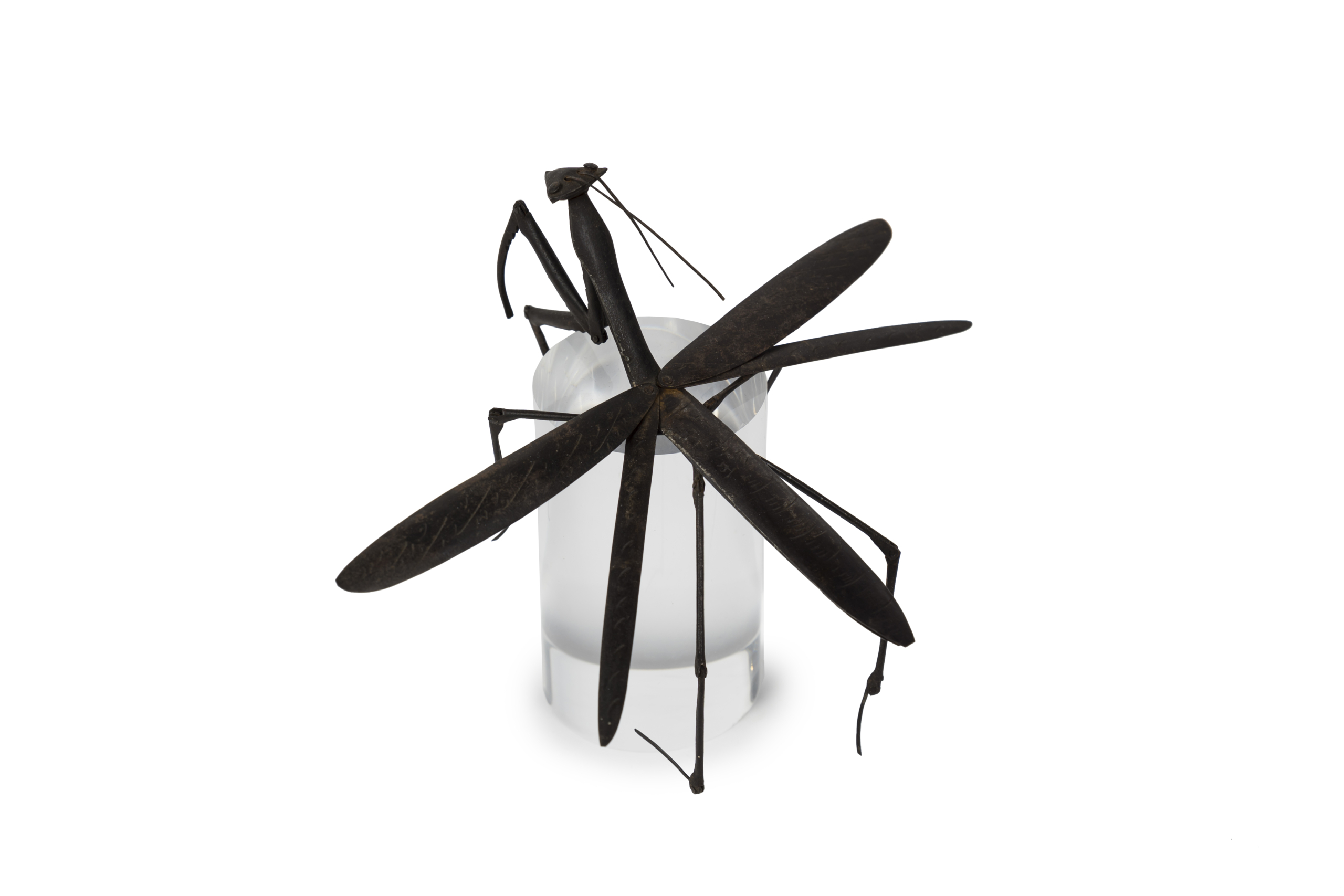
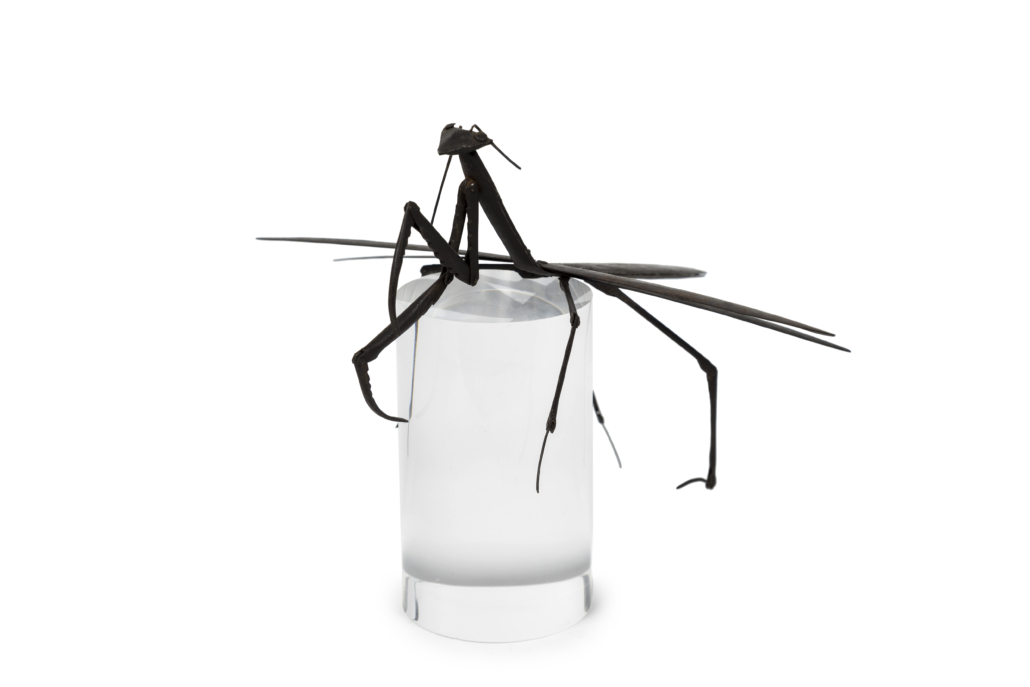
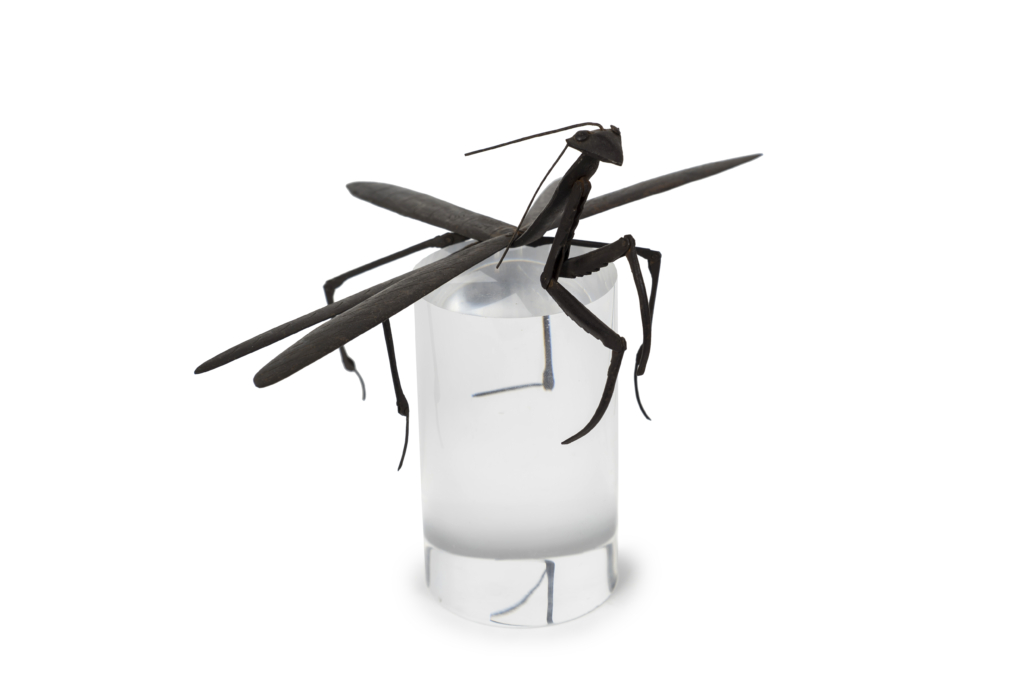
Imposing jizai okimono or articulated sculpture made entirely of hammered iron and signed Myochin, referring to an illustrious family of blacksmiths. Although originally a family of craftsmen whose genealogy dates back to the 4th century, the family’s fame began during the Heian era (784-1184) when it received its name “Myochin” (literally: “rare light”) from Emperor Konoe in the 12th century. From the 16th century onwards, the workshop became a school whose style and the influence of technical progress spread throughout the archipelago to the point where, in 1794, it became a supplier to the bakufu, providing armour for the shogunal government and therefore for both elite warriors and the powerful. Finally, the school’s blacksmiths were able to see Japan modernise in just a few decades under the Meiji era. In 1876, the Haitōrei decree was proclaimed, prohibiting the use of swords by anyone other than the military and the police. The aim of this measure was to reduce the influence of the samurai, modernise the imperial army and avoid a second revolt similar to the Boshin War. The ban led to a decline in the production of katanas and armour. Many blacksmiths found themselves forced to renew their skills or turn to other trades. Many specialised craftsmen began making tools, knives and even bells and chimes (furin). However, one singular art form stands out from this complex transition period: jizai. When the most meticulous armourers, responsible for making kabuto (helmets) and maedate (family ornaments, usually in bronze, used as coats of arms), found themselves without customers, they came up with the idea of producing very fine sculptures made in nature, combining the striking realism of certain maedate with the articulatory engineering of the finest pieces of armour.
Jizai Okimono are realistic sculptures of animals, generally divided into the following categories: birds, crustaceans, insects, but also imaginary animals such as dragons and shachi (aquatic monster similar to fish). They are generally made from iron, shibuichi copper (an alloy of copper and silver) or shakudo (an alloy of copper and gold), but can also be made from deer antlers or ivory. Their bodies and limbs are articulated and can be moved in the same way as a living animal. This type of okimono (decorative object) is little known in Japan because they were mainly exported from the beginning of the Meiji period to the end of the Showa era.
Jizai Okimono began to attract the interest of the Japanese public in October 1983, when several models were presented at a special exhibition on “Japanese Metal Art” held at the Tokyo National Museum. The pieces on display included a dragon, a falcon, a shachi, a carp, a lobster and a crab. Shortly afterwards, a number of Jizai animals from the British Museum were included in the exhibitions “Masterpieces of Japanese and Chinese Art from the British Museum” at the Tokyo National Museum in 1987 and “Daei Hakubutsukan Hizo Edo Bijutsu Ten (Exhibition of Edo Period Art from the British Museum Collections)” at the Tokyo Metropolitan Art Museum in 1990.
Public interest in Jizai okimono continued to grow when the exhibition “The Art of East and West at World Fairs” was held from July 2004 to March 2005 at the Tokyo National Museum, the Osaka Municipal Museum of Art and the Nagoya City Museum, and included a dragon, a carp and a praying mantis from the Japanese collections, as well as a lobster on loan from the Linden Museum in Stuttgart.
As far back as 1888, the French magazine “Le Japon Artistique” published detailed illustrations and an explanation of an articulated frog made by Myochin Muneharu. They also appeared in Japanese art auctions in the early days.
Insects are basically made in the same way as crustaceans, joining the legs with rivets. The wings of butterflies and dragonflies are attached to the body with hinges to make them mobile, while those of beetles and praying mantises, which cover the lighter wings, can be opened to spread the more fragile wings.
In Japan, the mantis is known as kamakiri (カマキリ), a word referring to the verb ‘to mow’ and to this tool. Although equipped with wings, mantises can only fly very short distances and are opportunistic predators that wait for their prey to remain motionless for long hours. The species known as Okamakiri is the largest of the nine species found in Japan and can reach a length of nine centimeters. Mantises are fascinating insects, related to both termites and cockroaches. In fact, they are considered so opportunistic that they will eat anything they can get their hands on, including a fellow insect. Cannibalism is a recurrent phenomenon between mantises, especially during the mating season. Sometimes the females consume their partners even before mating is complete. Although the Japanese collect insects they call mushi, and the mantis is a frequent catch, it would seem that this insect has little cultural importance compared with the snail, the butterfly, the dragonfly or even the firefly, each of which has its own poem, songs and myths. Nevertheless, it is still possible to find a recent occurrence of this insect in Japanese popular culture, demonstrating that it has long been treated in Japanese art. For example, a ¥700 stamp was issued in 1995, based on an Edo-era print by Sakai Hoitsu entitled ‘Hibiscus, Chrysanthemums and Mantis in Autumn’ (Aki no Fuyō to Kiku). (Aki no Fuyō to Kiku to Kamakiri=秋の芙蓉と菊とカマキ).
The praying mantis can be found in many fields and gardens and is associated in the Japanese collective imagination with the “wilderness” that is often seen at traditional summer and autumn festivals. The ancient Japanese calendar is an ancestral lunisolar calendar that divides the year into 72 micro-seasons of just a few days each. Each of these is associated with a natural event characteristic of the period in which it falls. In fact, Bôshu (芒種), a micro-season associated with the harvest, takes place in the middle of the summer season (夏 Natsu), a unique time to observe the profusion of insects, particularly fireflies and praying mantises hunting in the tall grass.
It is at the end of this period that the festival of Kajô no hi (嘉祥の日), the day of sweets, takes place. But also the celebration of Tsukimi, a summer festival celebrating the end of summer, thanking the lunar goddess with offerings for the success of the harvest. But all this is just a pretext for admiring the beauty of the autumn moon.
Japan – Meiji period (1868–1912)
Height: 12 cm – length: 20 cm – body width: 1.5 cm – wingspan: 21 cm