



WATERFALL AND MOUNTAINS SUZURIBAKO
Référence : 2025-1395
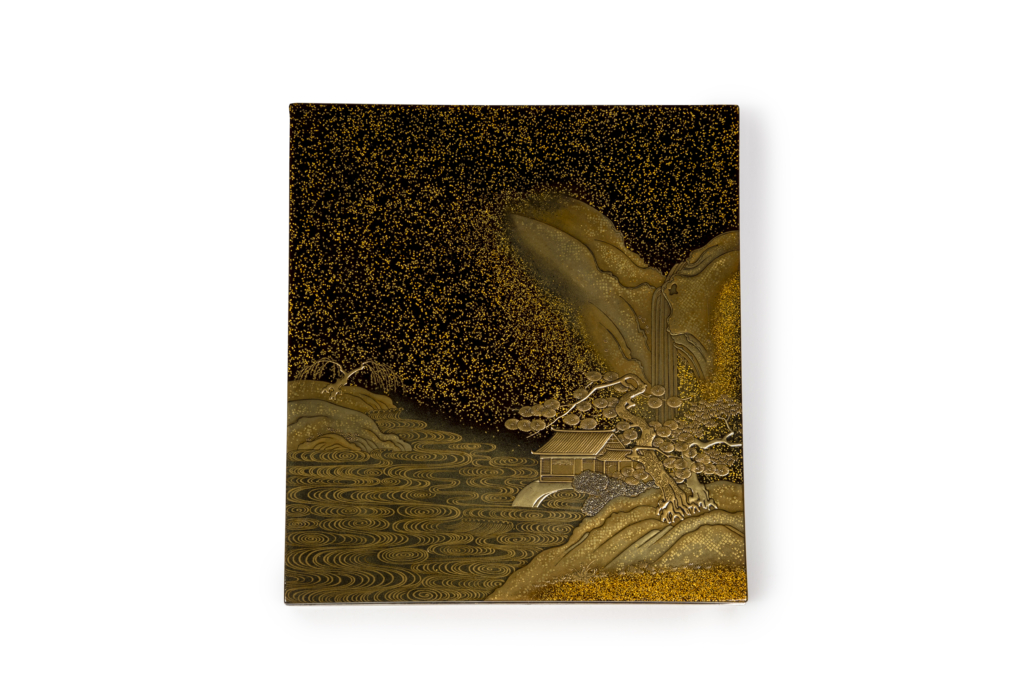
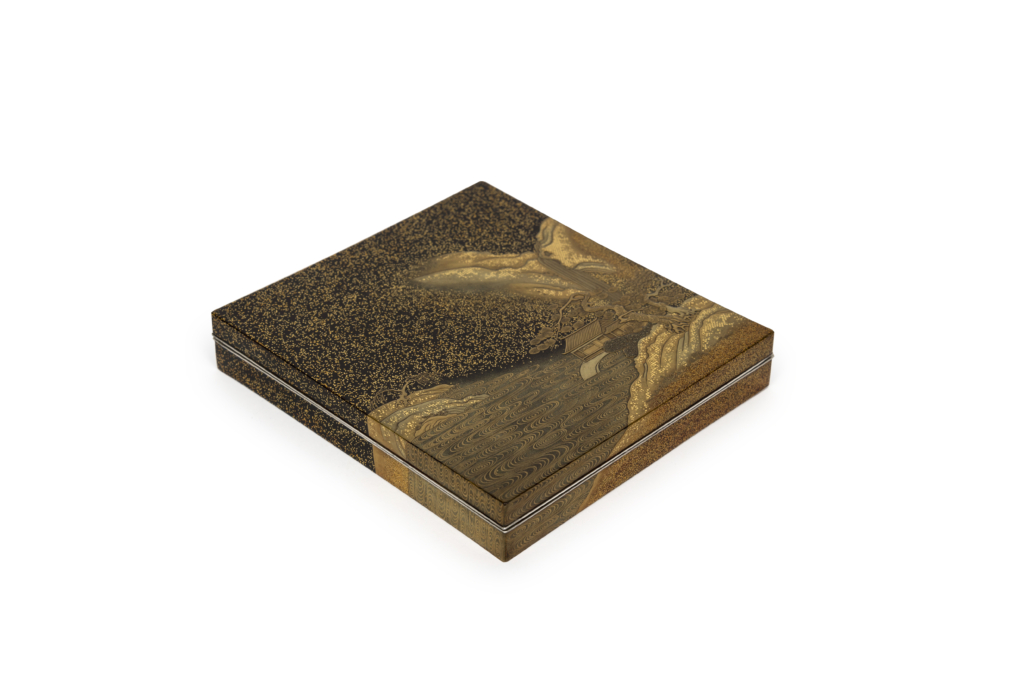
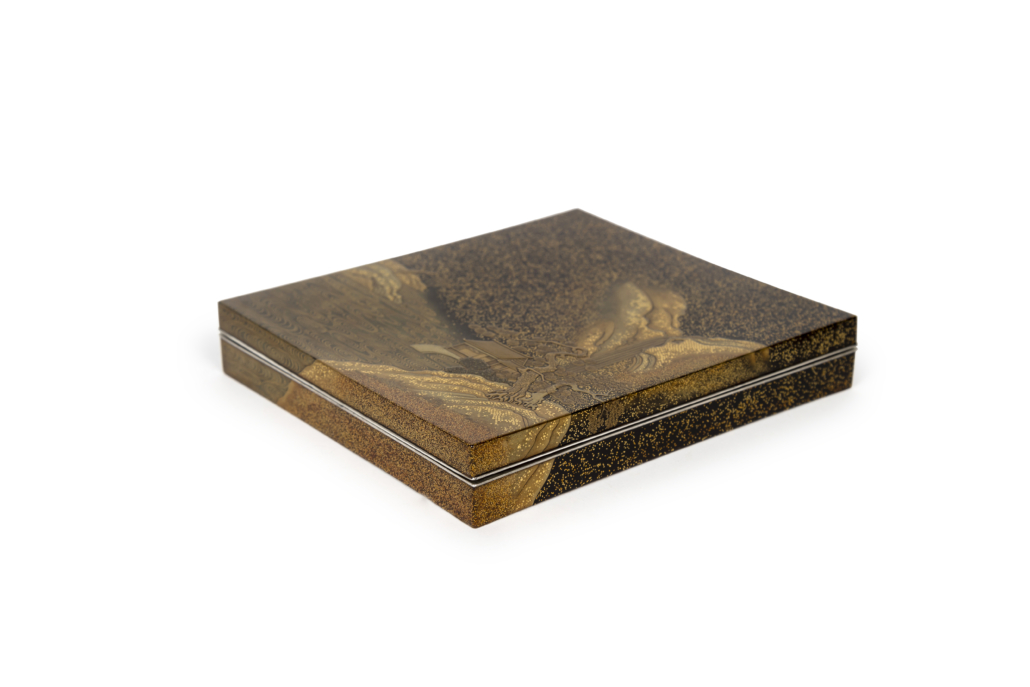
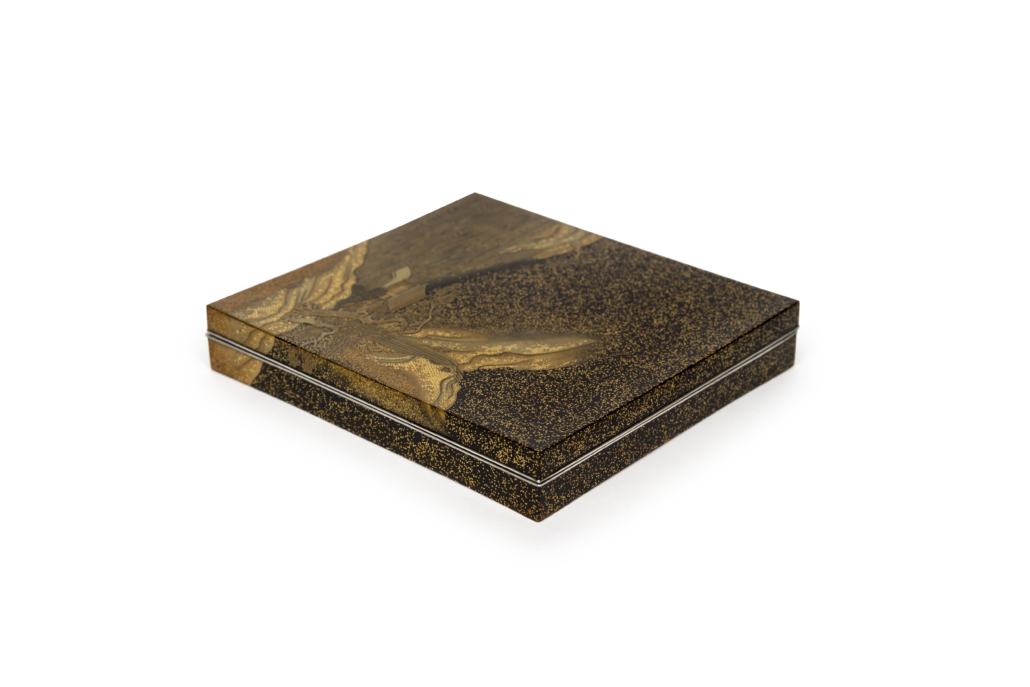
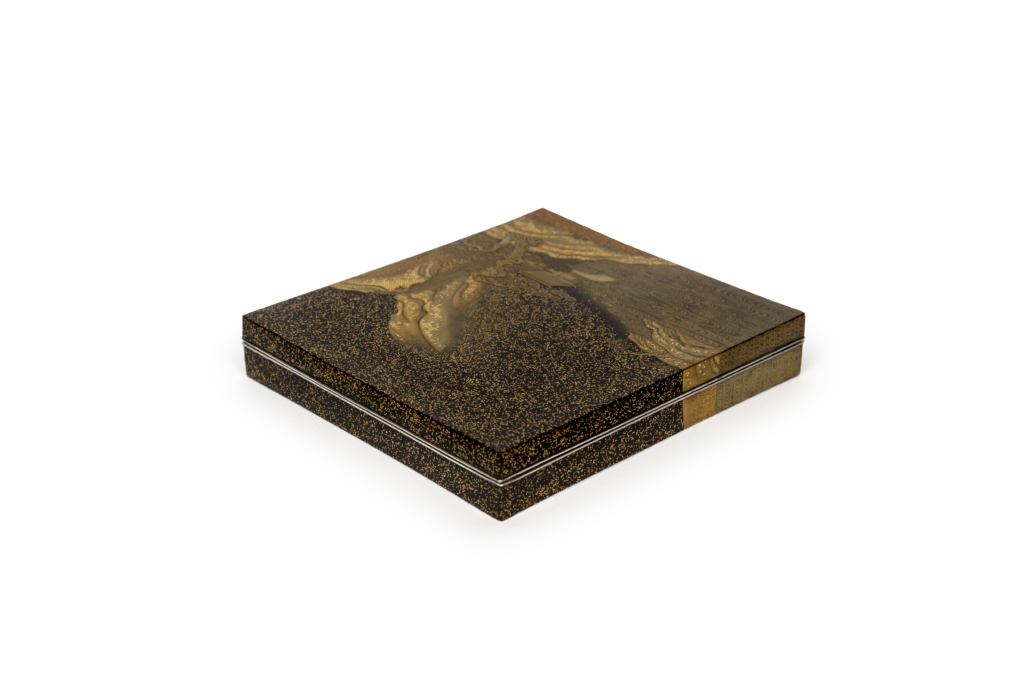
Suzuribako (writing box) in black lacquer, rectangular in shape, with a gold lacquer (maki-e) decoration of a pavilion by the edge of a waterfall and a mountain river surrounded by vegetation. The trees and the waterfall are in takamaki-e. The decoration itself covers the entire piece, continuing from the lid to each of the sides. One can see the use of kirigane creating a multitude of gold flakes of various sizes and shapes used in the sky, occupying a significant part of the cover, also to suggest the rocky and snowy texture of the mountains, and finally at the bottom of the foreground rocks but with the use of copper and gold. The river is stylized and features patterns of undulating waves. Camellia flowers (tsubaki) adorn the rocks in the foreground. The camellia is a flower rich in symbolism and deep meanings in Japan. This elegant and sophisticated flower is often associated with beauty, love, elegance, and longevity. It is often used in Japanese culture to express feelings of gratitude, admiration, and respect towards others. In addition to its positive meaning, the camellia is also considered a symbol of perfection and excellence. In Japanese culture, camellia flowers are often given as gifts to celebrate special occasions such as birthdays, weddings, and new ventures. Moreover, camellias are widely used in traditional Japanese rituals and ceremonies, where they bring a touch of beauty and grace. The camellia is therefore a highly appreciated flower in Japan, where it is revered for its symbolic meaning and timeless beauty.
Three weeping trees are present in the landscape: a weeping willow in the background and a pine tree and in the foreground. In Asia, the weeping willow is a tree often found in mythology. The City of Willows, Mou-yang-chen, in China, is the very place of immortality. In Lhasa, Tibet, the main sanctuary is located in the center of a plantation of weeping willows. This tree symbolizes life and spiritual elevation. It is often called the “tree of life” or “central tree.” It is also at the heart of a Japanese legend titled “The Samurai’s Willow.” The pine tree (matsu) is a tree rich in symbolism in Japan. Its longevity and resistance to the elements make it a symbol of strength and perseverance. Pines are often planted near shrines and temples to symbolize protection and wisdom. Their characteristic silhouette, with their twisted branches, also evokes the beauty of imperfection and the ability to overcome obstacles.
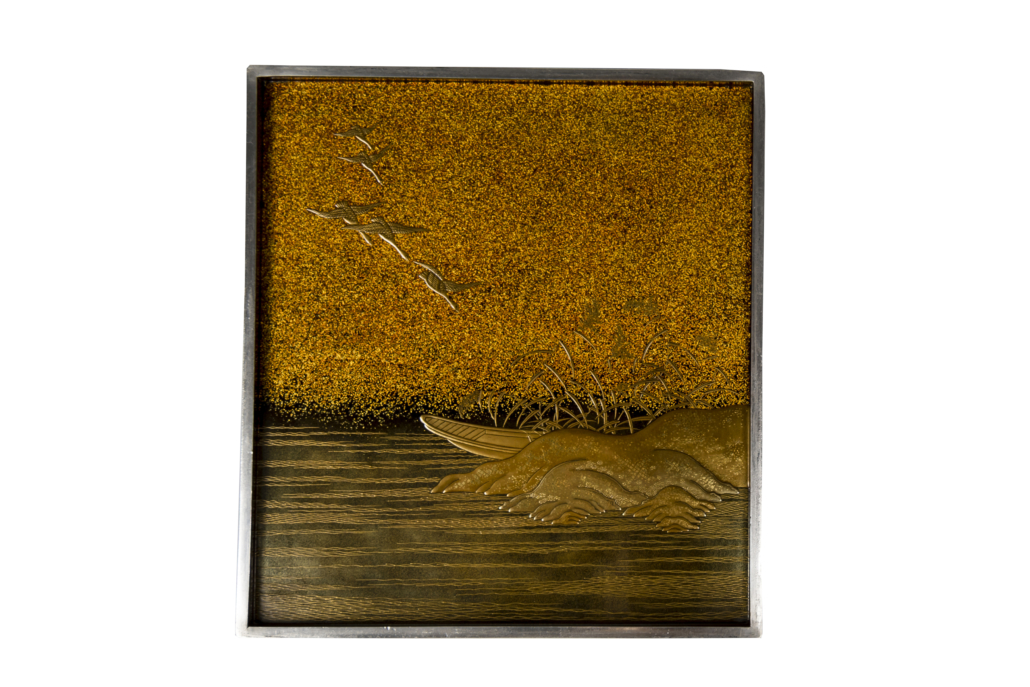
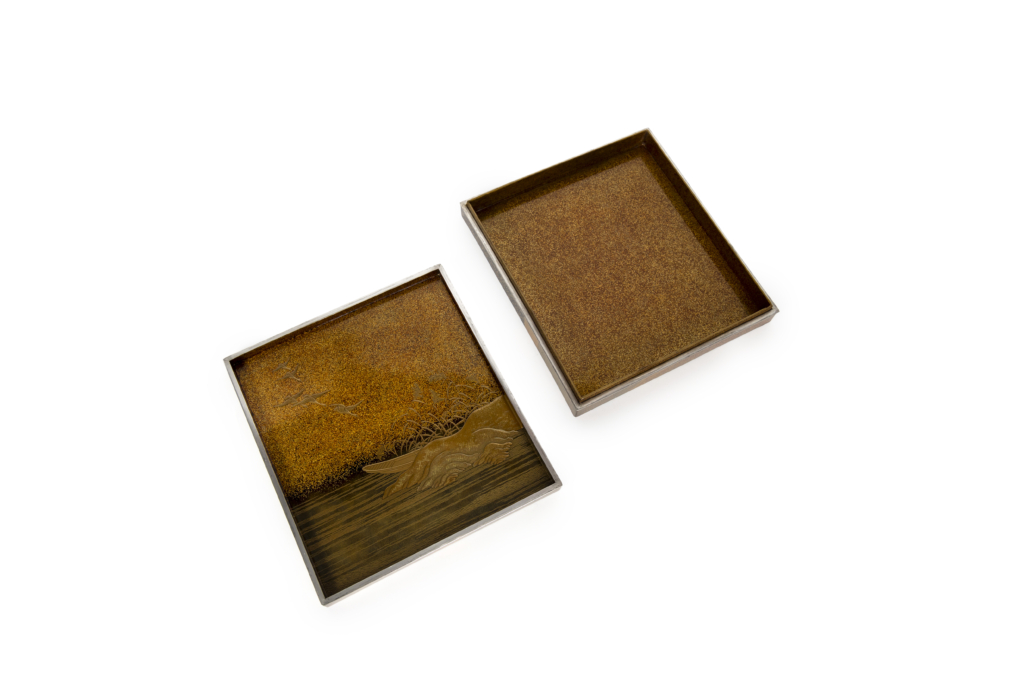
The interior of the suzuribako features the inkstone at its center. On the inner side of the lid, there is a decoration of a boat on the water behind rocks with cranes flying towards the ground. Again, the kirigane technique is used, particularly for the sky, which features numerous copper and gold flakes, as well as for the rocks, which are adorned with gold flakes only. The tall grasses behind the rocks are those of a miscanthus, a very common grass in Japan, appreciated for its simplicity and elegance, and well-known as it is frequently used in the traditional Japanese floral art of ikebana. The crane (tsuru) has a positive image in many cultures, particularly in China where it is a Taoist symbol of immortality. In Japan, it symbolizes peace, luck, and longevity, bringing 1000 years of happiness. By its color, its migration periods, and its environment, it is a mysterious bird also associated with fertility and wisdom. The Japanese crane is characterized by its white and black plumage and a red crown on the top of its head. It is very present in Japanese folklore, particularly in the tales Tsuru no Ongaeshi and Tsuru Nyōbō, a variant of the first tale. This one highlights the themes of gratitude, sacrifice, and the mystery surrounding the bird. It tells the story of a man who saved a crane caught in a trap, and in gratitude, she transformed into a young woman and wove him a cloth from crane feathers that made him rich. The crane is also found in the Man’yōshū, the oldest collection of Japanese poetry, where it is mentioned as a messenger between heaven and earth. The legend of the thousand cranes (senbazuru) says that anyone who manages to fold a thousand origami cranes will be granted a wish by the deities.
Japan – Edo era (1603-1868)
Length : 17 cm – Width : 15,5 cm – Height : 3 cm