








CROWS FOLDING SCREEN – MEIJI
Référence : 2026-1515
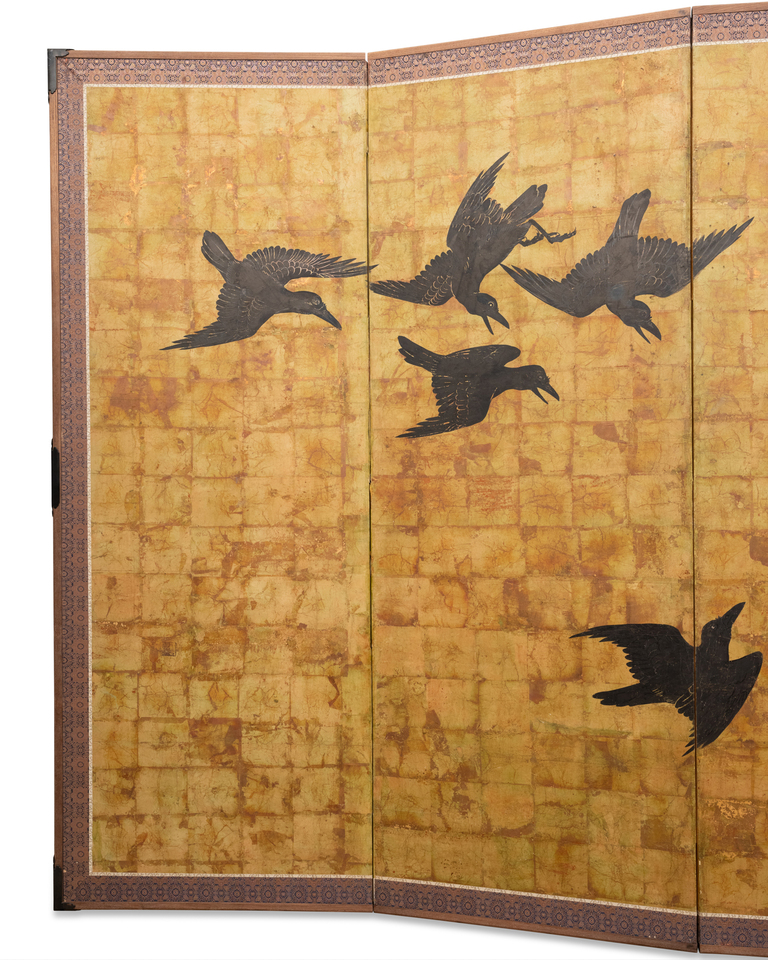
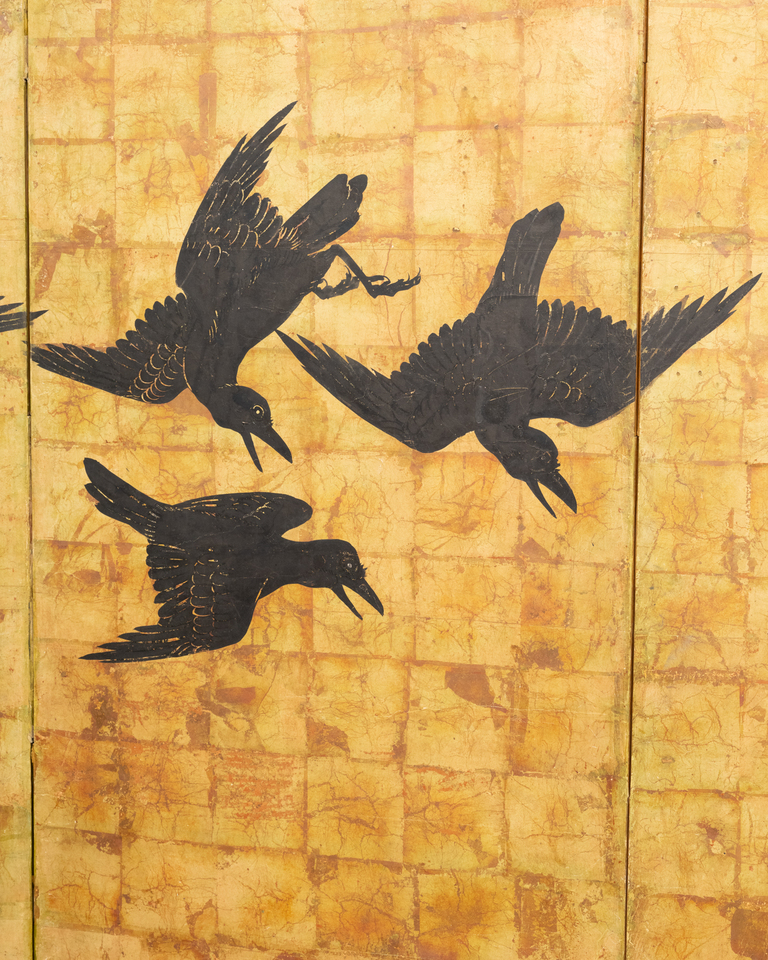
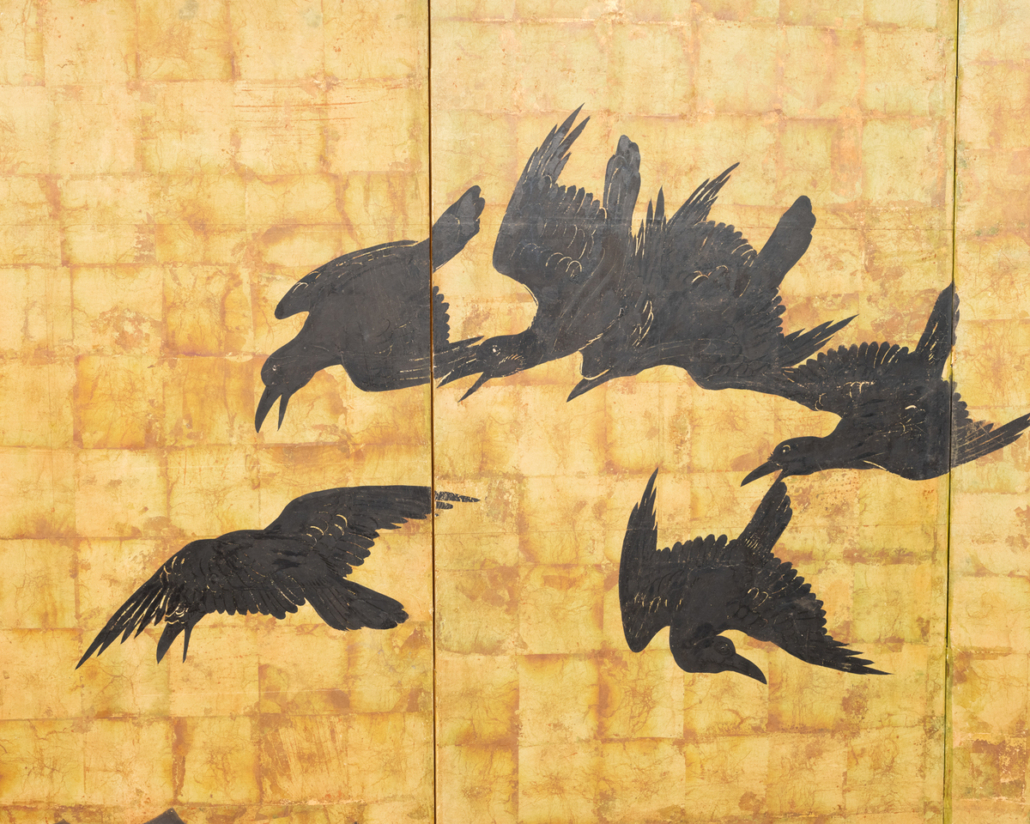
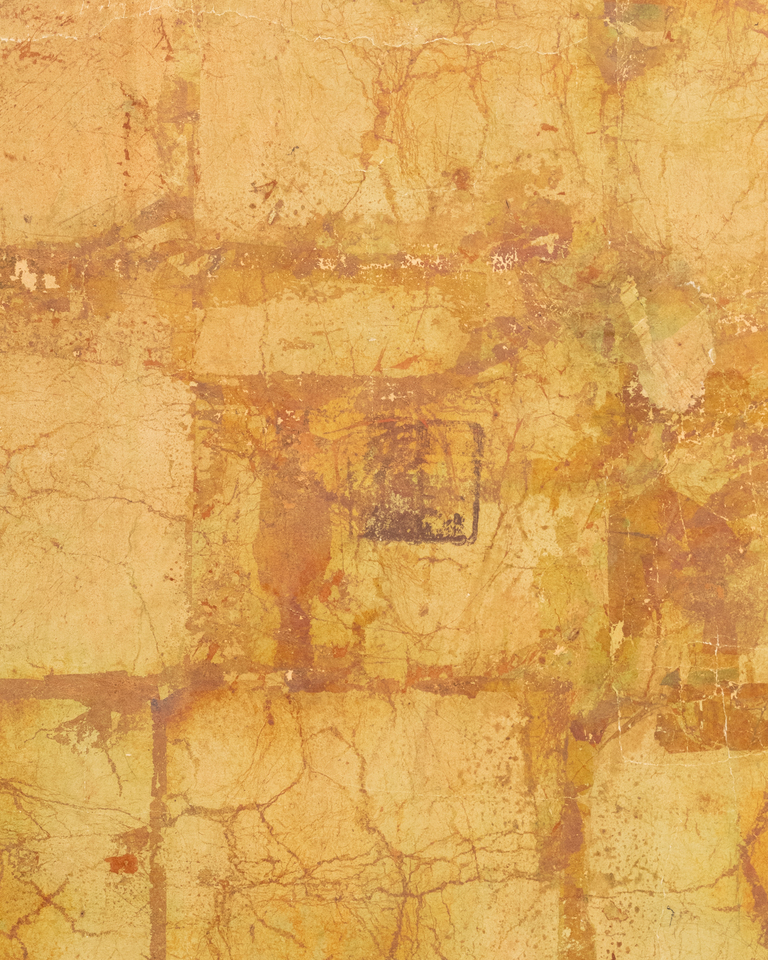
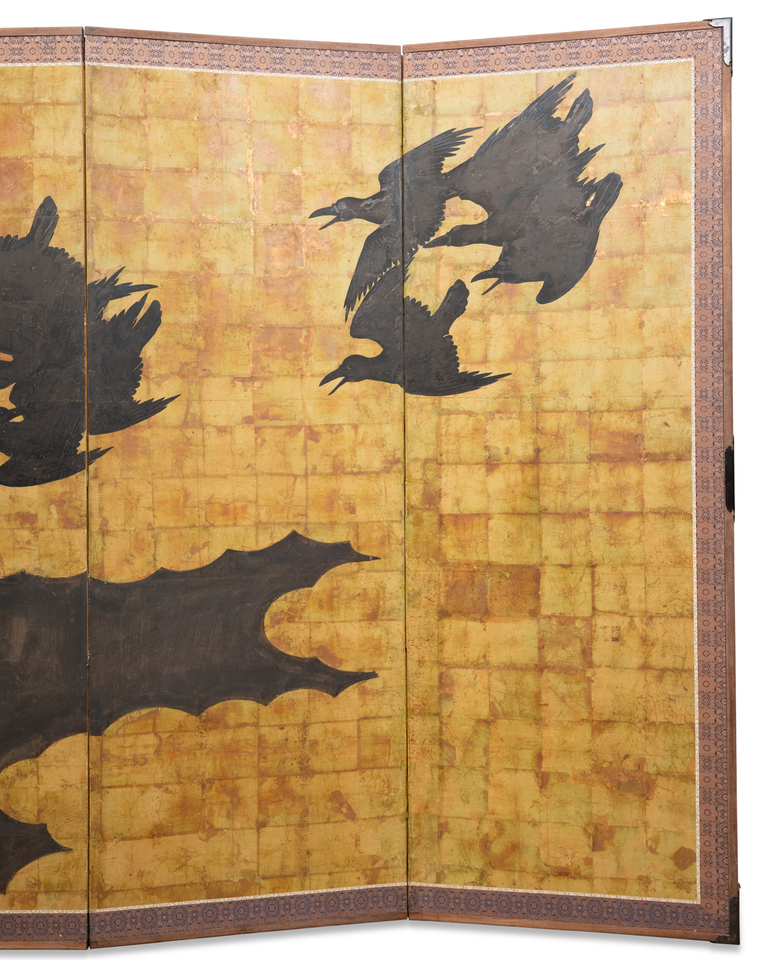
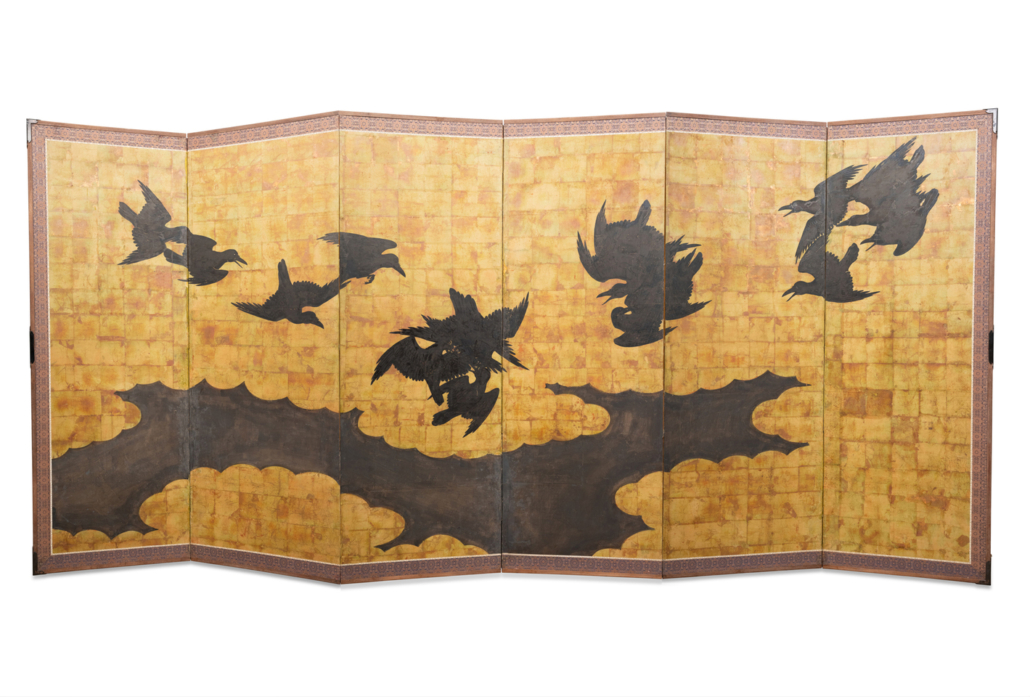
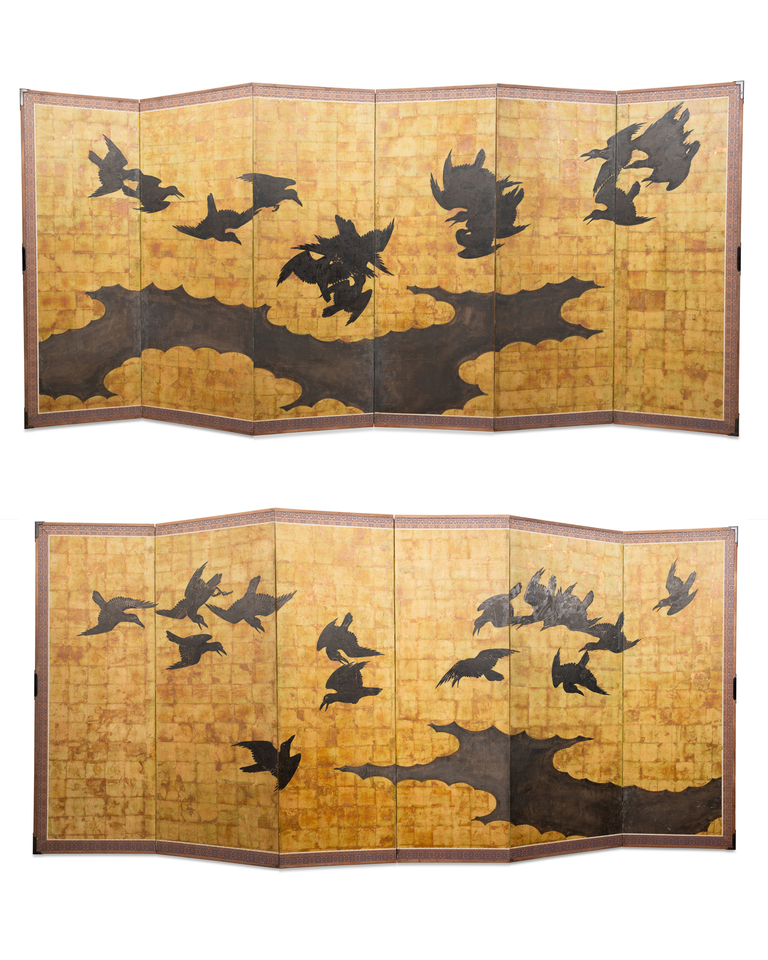
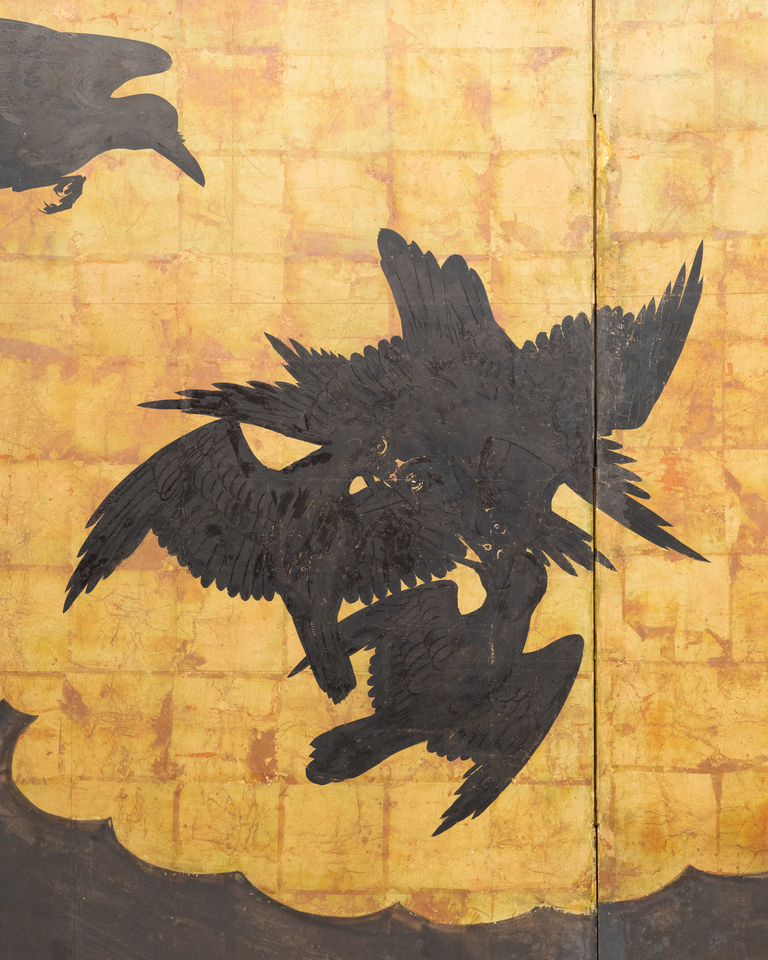
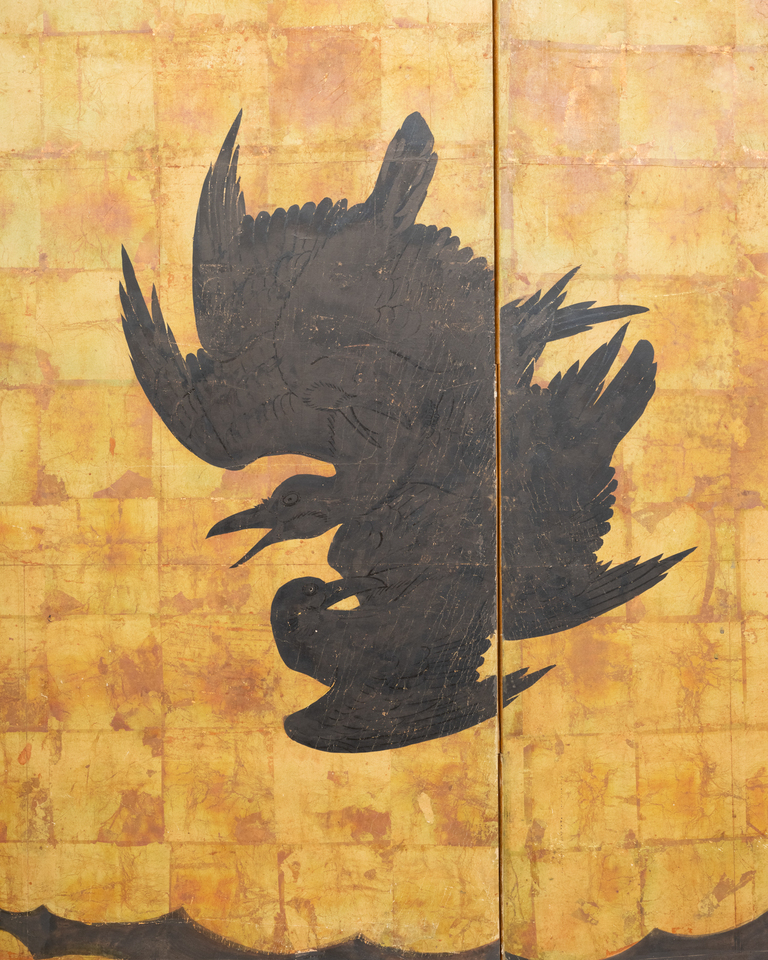
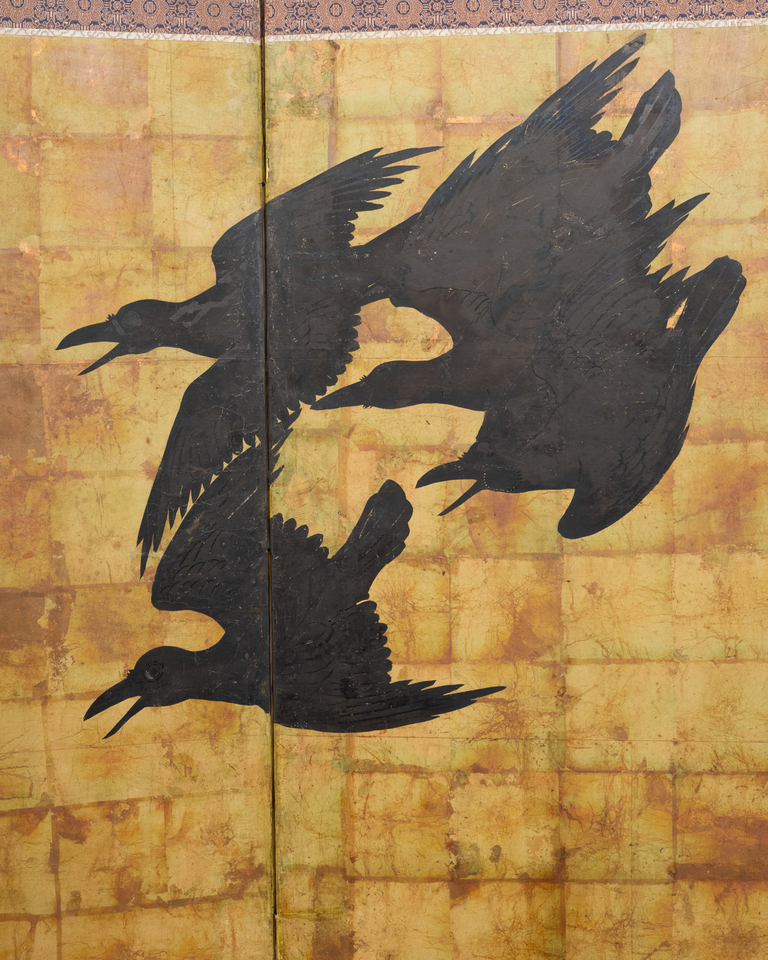
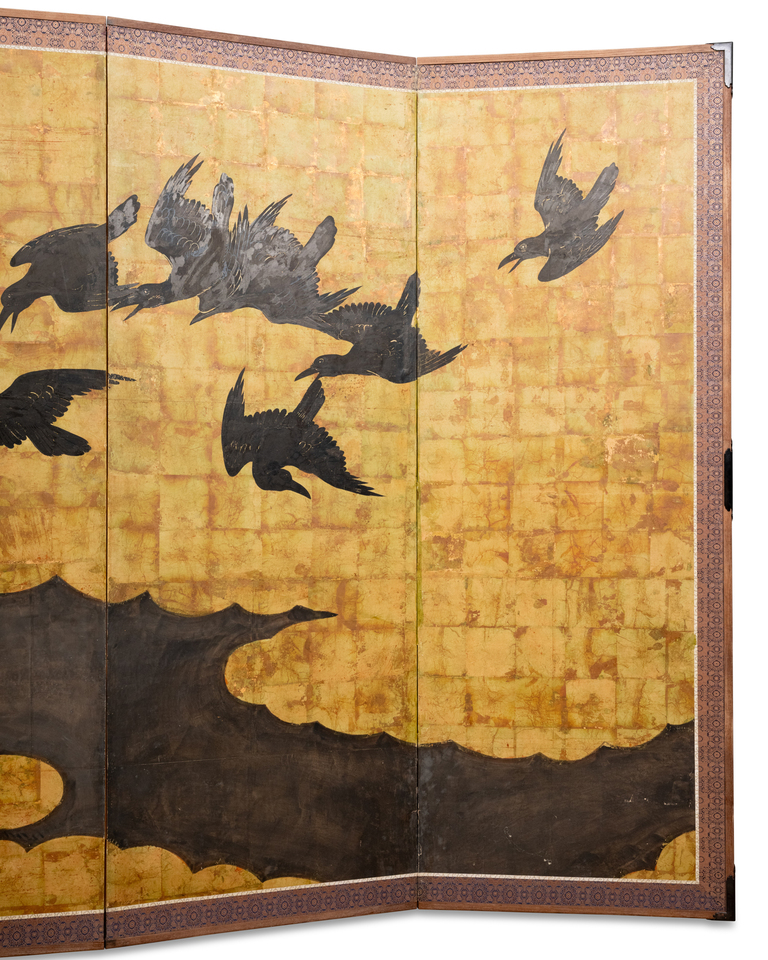
A pair of six-panel paper folding screens (byōbu), each decorated on one side only and depicting a continuous naturalistic scene of several flocks of crows (karasu) rendered in ink wash and swirling amidst clouds suggested by a gold-leaf ground, the lower portion of which reveals a nocturnal sky. Each crow is executed with remarkable attention to detail: from the feathers and eyes to the nostrils, every feature is individually painted using ink of varying intensity in order to distinguish it from the body without unnecessarily complicating the composition. Two crows, one on each screen, are depicted with their legs visible, their impressive precision of execution further enhancing the naturalism of the overall scene.
The composition recalls the animal paintings of Shibata Zeshin (1807–1891). A master lacquer artist, calligrapher, and painter, Zeshin is widely known in Japan and abroad for incorporating Western stylistic elements into his work between the end of the Edo period (1603–1868) and the middle of the Meiji era (1868–1912), while maintaining a strong attachment to distinctly Japanese subjects and compositional approaches. This synthesis of both domestic and foreign influences was instilled in him by his teacher, Suzuki Nanrei, a prominent member of the Maruyama-Shijō school, which remained somewhat peripheral to the official centres of artistic training represented by the Kanō and Tosa schools. In contrast to the highly stylized landscapes and animal subjects derived from Chinese literati painting that characterized the former, and the courtly scenes of Heian-period Japan (794–1185), inspired by the earliest native Japanese pictorial tradition known as yamato-e, that typified the latter, the Maruyama-Shijō school distinguished itself through its faithful representation of observed subjects. This pictorial realism, combined with decorative natural scenes and highly dynamic compositions, is characteristic of many of Shibata Zeshin’s works. Among them, a confectionery box (kashiki) [1] produced during the 1880s and now preserved in the Tokyo National Museum features a decoration of crows and herons in black lacquer, each bird rendered individually and with great precision, all flying in a single direction. The dynamism of that composition and the treatment of the birds could very well have served as inspiration for this pair of screens. Other examples of Zeshin’s interest in vivid depictions of corvids include an ink and colour print dated 1888 and preserved at the Minneapolis Institute of Art [2], as well as a two-panel screen housed in the Metropolitan Museum of Art, New York [3].
The byōbu is a traditional Japanese art form consisting of painted folding screens composed of hinged panels. These screens frequently bear scenes of considerable decorative and pictorial complexity. The most common format is the six-panel screen. Originally intended as windbreaks, byōbu were also widely used as room dividers to ensure privacy and, above all, as decorative furnishings.
The crow, or karasu, occupies an ambivalent position in Japanese culture. As a messenger of the gods, it may be regarded both as a bird of ill omen, associated with disasters and particularly nocturnal fires, and as a divine guide. According to legend, Japan’s first mythical emperor, Jinmu (c. 660–c. 585 BCE), was assisted in his quest to reach the land of Yamato (present-day Nara Prefecture), where he established the imperial lineage, by a giant crow. The bird is also associated with the legend of the Yatagarasu, a three-legged crow originating in ancient Chinese mythology, according to which this red-plumed crow resides within the Sun itself. Owing to this sacred and multifaceted nature, crows are traditionally never killed in the vicinity of the Shinto shrines of Kumano.
Japan – Meiji era (1868–1912)
Height: 177 cm – Width: six panels of 62 cm each, for a total width of 372 cm (744 cm for the pair)
[1] https://colbase.nich.go.jp/collection_items/tnm/H-4251?locale=ja
[2] https://collections.artsmia.org/art/62348/crows-flying-at-sunset-shibata-zeshin